Big AL Consulting UAE and Saudi Google Ads Budget Guide 2026
How much should you spend on Google Ads in the UAE or Saudi Arabia? This guide gives you the method, the real click prices by industry and a worksheet to set a monthly budget you can defend to your finance team.
9 pages · PDF · English
Get the guideWhat is inside
- The three-number budget method: leads, conversion rate and cost per click
- Top-of-page bid ranges for 8 industries in the UAE and Saudi Arabia, from a Keyword Planner pull of 28 September 2026
- UAE versus Saudi: the same search terms priced side by side
- How to split one budget across brand, core and competitor campaigns
- What to expect in month one versus month three
- A fill-in budget worksheet for your own numbers
Who it is for
Owners and marketing managers deciding what to spend on Google Ads in the UAE or Saudi Arabia.
Common questions
Where do the click prices in the guide come from?
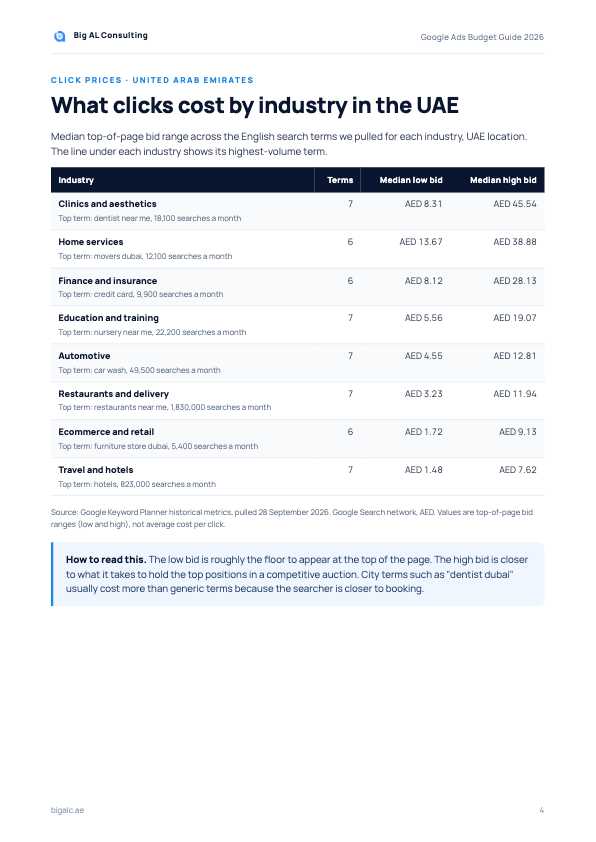
From Google Keyword Planner historical metrics pulled on 28 September 2026 for UAE and Saudi Arabia locations, Google Search network, in AED. They are top-of-page bid ranges, which is what Google estimates an advertiser pays to appear at the top of the page, not a guaranteed average cost per click.
Is the guide only for Google Ads?
Yes. It covers Google Search budgets in the UAE and Saudi Arabia. For Meta, TikTok and Snapchat planning use the 90-Day Paid Ads Media Plan Template.
Do I need an existing Google Ads account to use it?
No. The method works for a new account. If you already run ads, replace the planning assumptions with your own conversion rate and cost per click from the last 90 days.
Sources the Big AL Consulting team checked
Official platform documentation, regulators and primary data behind the points on this page, checked by the Big AL team.
- 1Actual cost-per-click (CPC): DefinitionGoogle Ads HelpThe final amount charged for a click is often less than the maximum bid.
- 2Digital 2026: The United Arab EmiratesDataReportal (Kepios)Internet, social media and ad reach figures for the UAE.
- 3About Ad RankGoogle Ads HelpWhy ad position and price are decided in a live auction, not a fixed rate card.
- 4Digital 2026: Saudi ArabiaDataReportal (Kepios)Internet, social media and ad reach figures for Saudi Arabia.
- 5Understanding bidding basicsGoogle Ads HelpHow bids, budgets and bid strategies relate to what you pay.
- 6Use Keyword PlannerGoogle Ads HelpThe official tool behind search volume and top of page bid estimates.
- 7Set and change an average daily budget for your campaignGoogle Ads HelpHow average daily budgets work and how daily spend can vary.
- 8Google TrendsGoogleRelative search interest over time and by region.
Links checked: 2026-09-28
About the author

Big AL Consulting is a performance marketing agency in Dubai and a Google Partner since 2021. We run paid media across Google, Meta, Snapchat, TikTok, LinkedIn and ChatGPT ads for brands in the UAE, Saudi Arabia and Kuwait, and have managed $25M+ in ad spend.
Written by Ahmad Alshareefi, Founder
How we make our guides: we use AI tools to help draft, and build each guide on our own campaign experience in the UAE and Saudi Arabia and on the ad platforms' official documentation.
More guides and tools
All guides and toolsMore questions
How does the budget guide suggest splitting a Google Ads budget across brand, core and competitor campaigns?
The guide treats brand, core and competitor searches as three separate campaigns that each deserve their own share of one budget, rather than one pool that spends wherever Google sends it. Brand covers people already searching for your name, core covers the service or product terms that bring in new customers, and competitor covers searches for other providers in your category. Splitting the budget this way keeps the cheap brand clicks from masking the real cost of the core campaign and lets you decide deliberately how much to spend on each type of demand.
What does the budget guide say to expect in month one versus month three of Google Ads?
The guide sets different expectations for month one and month three, because a new account spends its first weeks learning which searches and ads produce leads, while by month three the data has had time to settle. Budgeting on month one results alone usually makes Google Ads look worse than it is, and budgeting on an optimised steady state from day one sets a target the account cannot meet yet. Separating the two periods gives a finance team a realistic path. Advertisers with existing data can anchor both periods on their own last 90 days.